
This is the label.
A cellular tracker the size of a shipping label. Press, stick, scan. It reports door to door from 200 countries and territories, and goes silent in the air by itself.
Watch the 40-second activation guide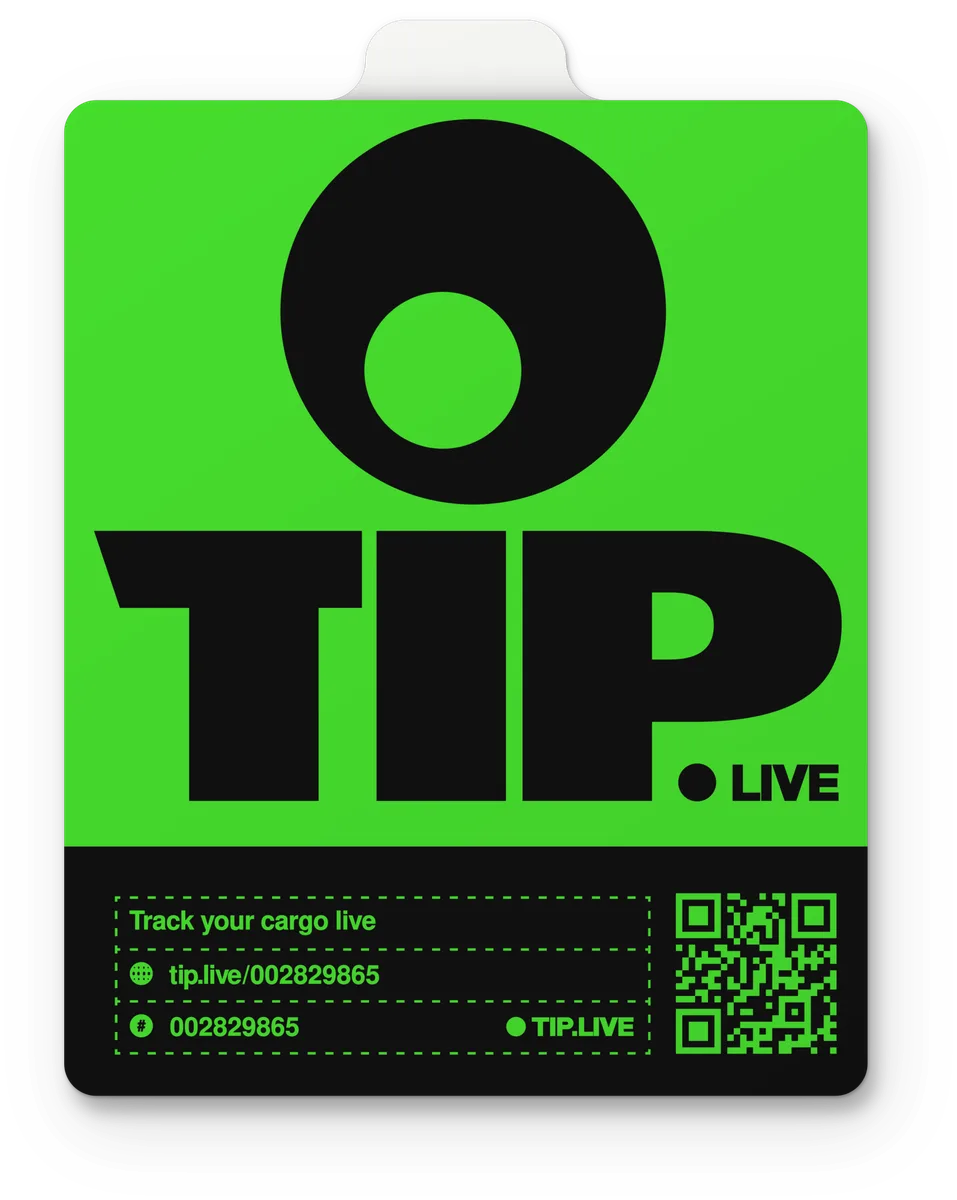
124 × 101mm
card size
4.2mm
thin
56g
with battery
200
countries & territories
60+days
operating life
What it is.
What it is not.
Cellular.
Reports through mobile networks in 200 countries and territories.
Door to door.
One label from the shipper’s floor to the consignee’s.
Works where GPS does not.
Inside trucks, containers and warehouses: wherever a phone has signal.
Automatic in the air.
Goes silent at take-off, reports again after landing.
Single use.
No charging, no returns, no fleet to manage.
Self-contained.
No app, no account, no tools to activate.
Not GPS.
Position comes from the cell tower, not a satellite: hundreds of metres, not metres.
Not live at sea or in the air.
No network at sea; transmitter off in flight. It reports again at the next port or after landing.
Not afraid of rain.
It rides on the outside of the cargo, no cover needed.
Not switchable off.
Once activated it runs until the battery is spent.
Specifications
Everything you can measure with a ruler, a scale or a regulatory database. How it is built stays in the approval pack.
Physical
- Size
- 124 × 101 × 4.2 mm. A flat, rigid card.
- Weight
- 56 g, battery included.
- Form
- Printed front, adhesive back with a peel-tab liner. One label per parcel, carton or pallet.
- Ports
- No ports, no connectors, no charging port, no SIM slot, no exposed conductors.
- Markings
- Unique serial number and QR code on the front. The serial is also the tracking address: tip.live/‹serial›.
Connectivity
- Network
- LTE Cat-1 bis with 2G fallback.
- Why LTE Cat-1 bis
- Cat-1 bis is LTE Cat-1 for small single-antenna devices. It runs on the same LTE networks as a phone and roams like one, with 2G where LTE is missing. NB-IoT is patchy across operators, rarely roams across borders and was built for things that do not move.
- SIM
- Built-in multi-network softSIM. No SIM to insert, no roaming to set up.
- Coverage
- 200 countries and territories. See the operators by country
- Other radios
- No GPS. No Wi-Fi. No Bluetooth in use. Internal antenna.
Positioning
- Method
- By the mobile network, not by satellites. GPS needs a clear view of the sky; cargo spends most of its journey inside a truck, a container or a warehouse, where there is no GPS signal but there is mobile signal.
- Typical accuracy
- A few hundred metres in cities, several kilometres in open country. Enough to know which depot, port, airport or city, not which shelf.
Reporting
- Update interval
- Every 60 minutes by default.
- Adjustable interval
- Minutes to days, set per shipment. Coming in the next version.
- Between updates
- The radio is powered off completely.
- In flight
- No updates. The transmitter is off from take-off to confirmed landing. How flight mode works
Power
- Battery
- Non-rechargeable lithium manganese dioxide (Li-MnO₂), sealed inside, not replaceable: the chemistry of ordinary CR coin and camera cells. Lithium content under 1 g, the IATA limit. UN 38.3 tested.
- Charging
- None. No charging circuit, no external power input.
- Operating life
- 60+ days at the default 60-minute update interval. Single use.
- Shelf life
- 12 months from production before activation. Store below 30 °C, dry, out of direct sunlight.
- Disposal
- Like any small device with ordinary household batteries: an electronics or battery collection point. No special hazardous-waste handling.
Environment
- Operating temperature
- -20 °C to +60 °C.
- Weather
- Rain and dust are fine. It rides on the outside of the cargo without a cover. Not for immersion.
- Robustness
- Rigid housing with the battery and electronics bonded inside.
Activation
- Activation
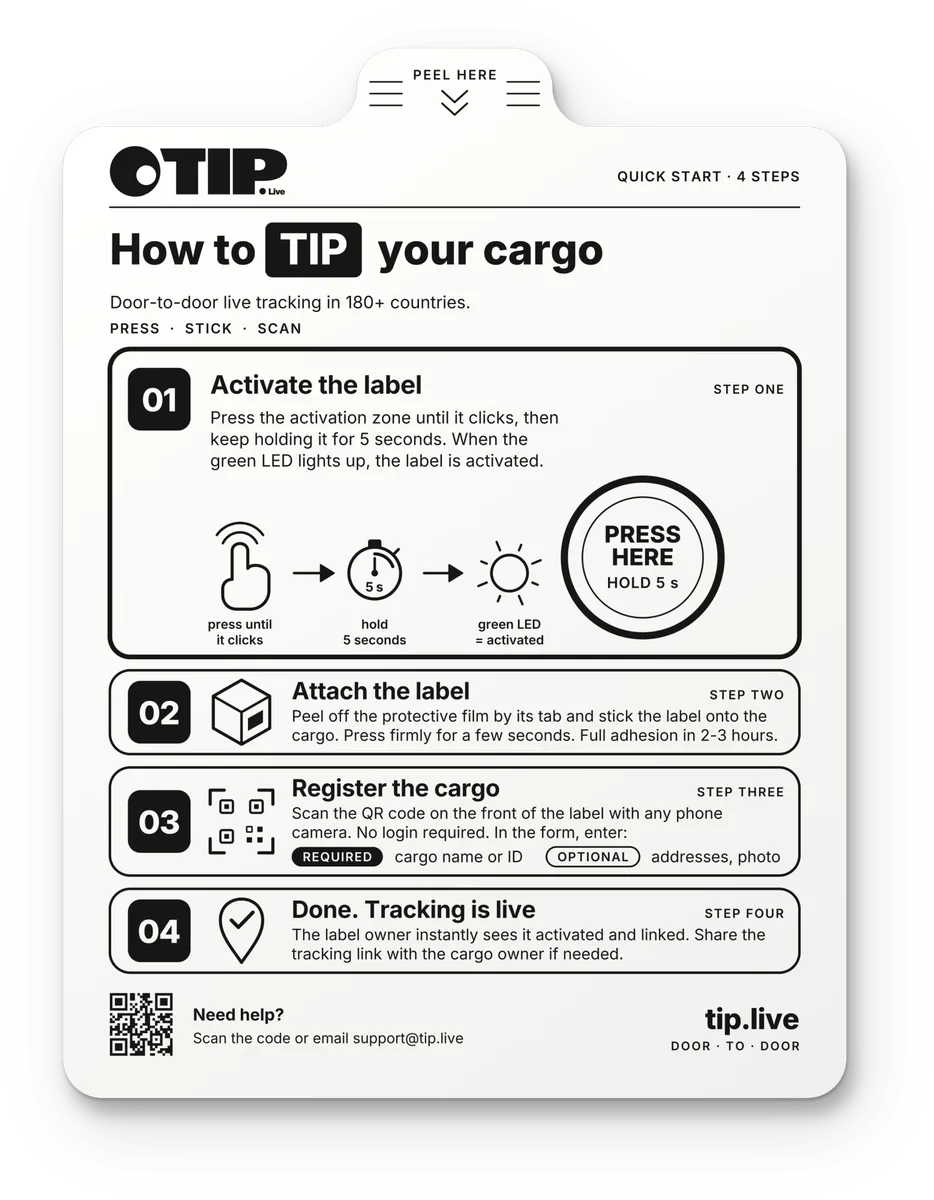
- Press and hold the activation zone on the back for 5 seconds; the green LED confirms. No tools, no app, no account.
- Before activation
- Fully powered off. No radio, no logging.
- After activation
- Runs until the battery is spent. No off switch.
- Registration
- Scan the QR code on the front with any phone camera to register the cargo. No login. Share the tracking link with anyone; it opens in a browser.
In use.
Which depot, not which shelf.
No satellite receiver, on purpose. GPS needs a clear view of the sky, and cargo spends most of its journey inside a truck, a container or a warehouse, where there is no GPS signal but there is mobile signal. The label is located by the mobile network cell it is connected to, so it keeps reporting from inside the vehicle, the container and the depot. In a city that is typically a few hundred metres; in open country it can be several kilometres. Enough to know which depot, port, airport or city your cargo is in, not which shelf. Expect no reports at sea between ports or deep inside a stack of steel containers, and none in flight, where the transmitter is off by design. The label reports again at the next network.
Where to stick it.
- A clean, flat, dry surface. Press firmly; full adhesion takes 2–3 hours.
- Cartons: on the side. Pallets: on the side of the load, under or over the wrap.
- Outside is fine. It rides on the cargo in the rain without a cover.
- Metal surfaces work too; they can weaken the signal a little.
Life of a label.
1
Sealed
Up to 12 months on the shelf before activation. Cool, dry, out of the sun.
2
Activated
Press the activation zone for 5 seconds until the green LED lights up. Press, stick, scan.
3
Reporting
Every 60 minutes wherever there is a mobile network. Silent in the air, by itself.
4
End of life
Battery spent. The radio is disabled for good and the label cannot restart. Dispose of it like any small device with ordinary household batteries.
Built to fly. Silent in the air.
Take-off is detected on the label itself by independent on-board sensors, backed by a fail-safe. The transmitter is powered off for the whole flight. Reports resume only after a confirmed landing and a hold on the ground. If the label cannot be sure it is on the ground, it stays silent.
No off switch.
Flight mode is fixed in the firmware. It cannot be changed by the shipper, the receiver, ground staff, or remotely. Not even by us.
At any interval.
Whatever the update setting, nothing is sent in flight.
Fails towards silence.
If the label cannot tell whether it is on the ground, it does not transmit.
Not dangerous goods when in use.
What a forwarder or a dangerous-goods desk needs to know before the label travels. The signed documents behind every statement are in the approval pack.
By air, in use
On a consignment and in use, the L1 is a battery-powered cargo tracking device designed to meet every condition of IATA DGR 1.2.7.1(i) and the ICAO Technical Instructions: a non-rechargeable lithium metal battery with under 1 g of lithium, UN 38.3 tested, no charging circuit, a rigid housing, one label per consignment unit and a transmitter that is off in flight. Not subject to the dangerous goods provisions when in use.
By sea, in use
IMDG Code section 5.5.4: dangerous goods in equipment in use during transport. The battery is non-restricted under IMDG Special Provision 188.
Sealed labels in transit
Labels on their way to you, or sealed packs you forward to a supplier, ship as UN 3091, Packing Instruction 970 Section II by air and under IMDG Special Provision 188 by sea. When we ship, we prepare it. If you forward a pack yourself, your forwarder needs the lithium battery mark and the air waybill statement: ask us for the wording.
Tell your airline
Airlines accept active tracking devices under their own policies and approved-device lists. Tell your forwarder that a label is attached and have it noted in the air waybill handling information. We send the approval pack to any airline, ground handler or forwarder on request.
Radio and aircraft compatibility
Built around an EU-certified cellular module, the only transmitter in the label. Aircraft-EMI testing to RTCA DO-160G Section 21 is under way; the reports go to airlines on request once issued. IATA Air Cargo Device Assessment to follow. Ask us for the current status.
For parcels, cartons and pallets, and anything else that travels by road, sea and air.
Need the full file?
For shippers, forwarders, ground handlers and airline dangerous-goods desks.
- • Technical datasheet for customers
- • Dangerous-goods compliance letter, signed by TIP.LIVE LTD
- • UN 38.3 test summaries for the cell and the battery
- • Battery safety data sheets
- • IMDG non-restricted certificates
For airlines, ground handlers and dangerous-goods departments, under a short confidentiality agreement.
- • Full technical datasheet
- • Automatic flight-mode specification
- • Cellular module identity and radio certificate
- • Full battery test reports
- • Aircraft-EMI and device certification reports as they are issued
- • Serial-number lookup for a named consignment: production batch, firmware release, modem identity
TIP.LIVE LTD, London, United Kingdom: design authority and manufacturer.
Every label is traceable by serial number. Transport-relevant configuration changes are re-documented and airlines on file are notified.
Specifications current as of October 2026.
Questions shippers, forwarders and airlines ask
Getting started? Watch the activation guide.
Is a TIP label dangerous goods?
Does the label transmit during a flight?
Do I have to tell the airline?
Why no GPS, and how accurate is it?
Why LTE Cat-1 bis and not NB-IoT?
Can I change how often it reports?
Can I switch it off or reuse it?
How do I dispose of it?
Ready to Track Door to Door?
Get your first tracking label and follow your shipment from pickup to delivery.
Buy labels — from $20Press. Stick. Scan. Track.
Give your cargo a voice. See how to activate your label and start tracking.
Press.
Press the activation zone until it clicks, then hold for 5 seconds. Watch for the green LED.
Stick.
Peel off the backing, attach the label to your cargo and press firmly. Keep the green TIP face visible.
Scan.
Scan the large QR code on the green front with your phone camera. Enter your cargo name or ID, then register it. No login required.
Track.
Open your shipment view and share the tracking link with your team or consignee.
Full adhesion takes 2–3 hours.